Relative minors and enharmonics
A key signature does not point to a single key. It fits a major key and its relative minor, and near the bottom of the circle some keys have two names. Here is how to read both.
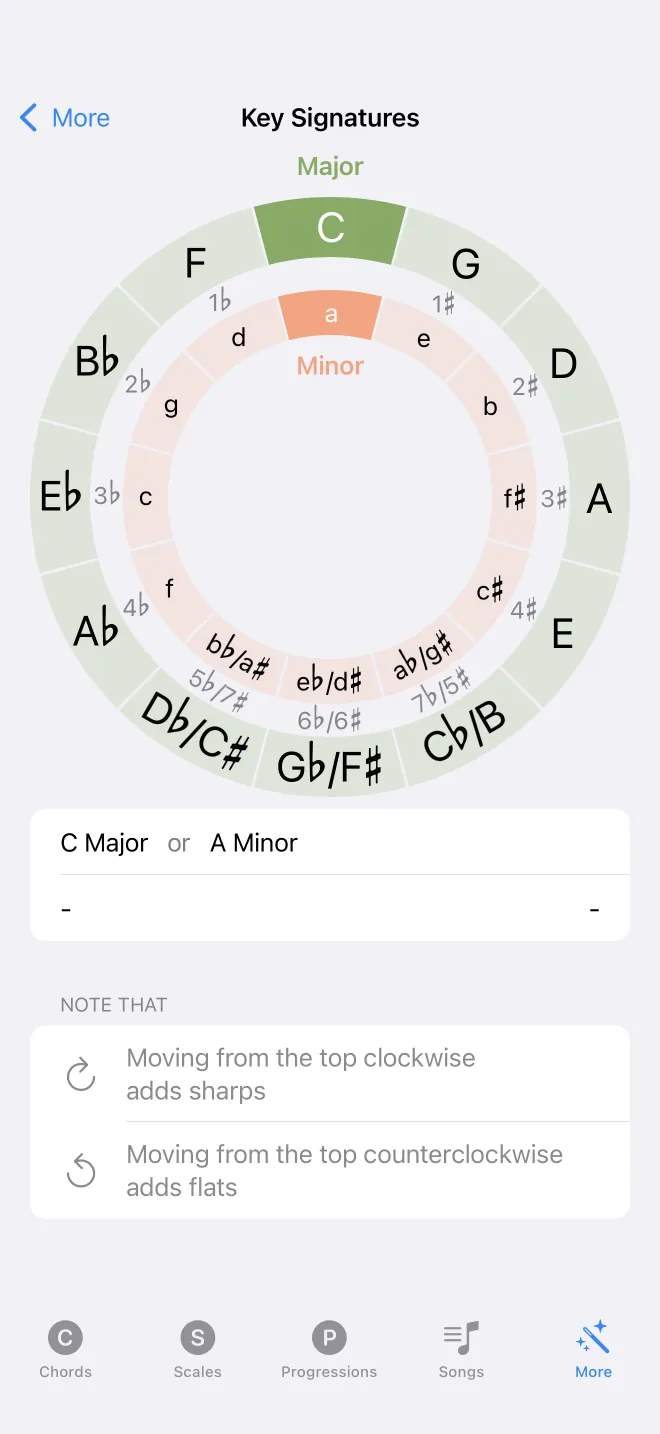
Relative minors
Every major key shares its signature with one minor key, its relative minor, shown on the inner ring of the chart. C major and A minor both have no sharps or flats. G major and E minor both have one sharp. When you see a signature it could mean either the major key or its relative minor, and the music tells you which by where it comes to rest.
Enharmonic keys
Near the bottom of the circle, some keys have two names for the same sound. G flat is the same as F sharp, D flat is the same as C sharp, and C flat is the same as B. The chart shows both names. Which one a piece uses depends on how it is written, but the sound and the keys on the piano are identical.
Key signatures across the app
You do not only meet key signatures on this chart. Every scale's detail screen draws the scale on the staff with its signature, and the circle of fifths uses the same ring of keys for building chords and progressions. The chart here is the reference; the rest of the app puts it to use.