Key signatures
A key signature is the group of sharps or flats written at the start of every line of music. It sets the key and saves you from marking the same sharps and flats on every note. This part covers what it means, why it matters, and how to read the chart.
What a key signature is
At the start of a staff, just after the clef, a piece may show a few sharp or flat symbols. That is the key signature. It says those notes are sharp or flat for the whole piece, so they are not marked again on every note. A signature of one sharp on the F line means every F is played as F sharp until the music says otherwise.
Why it matters
Two reasons. First, it keeps written music clean: a piece in a key with four sharps would otherwise need a sharp written on hundreds of notes. Second, the signature names the key at a glance, which tells you the scale the music is drawn from and the chords likely to appear in it. Reading, writing, and transposing all lean on it.
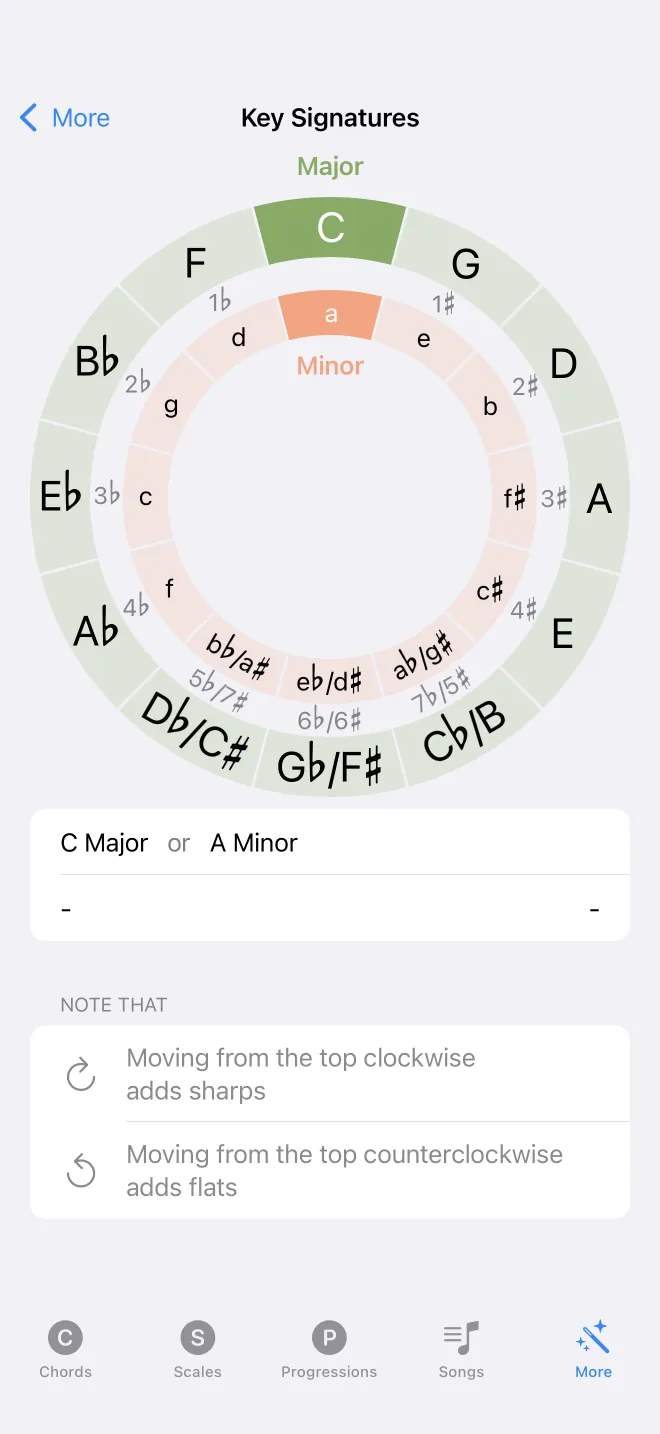
The key signatures chart
Open More, then Key Signatures. The chart is a circle with three rings. The outer ring is the major keys. The middle ring is the number of sharps or flats each key has. The inner ring is the relative minor of each key. Tap any key and it highlights, together with its relative minor, and its notes appear below the circle.
Reading the chart: sharps and flats
C major sits at the top with no sharps or flats. Moving clockwise, each key adds one sharp: G has one, D has two, A has three, and so on. Moving counter-clockwise from C, each key adds one flat: F has one, B flat has two, E flat has three. The middle ring shows this count for every key, so you can read how many accidentals a key has without working it out yourself.