E Whole Tone Scale
- Notes
- E F♯ G♯ B♭ C D
- Also called
- E whole-tone, E hexatonic whole tone
- Steps
- W W W W W W
- Degrees
- 1 2 3 ♭5 ♭6 ♭7
- Key signature
- none, sharps and flats are written as accidentals
The E Whole Tone scale has six notes: E, F♯, G♯, B♭, C, and D, then E again an octave higher. Every note is a whole step from the next, so the scale has no half step, no perfect fifth and no note that sounds like home. Only two whole tone scales exist: the scales on F♯, A♭, B♭, C, and D have the same notes as this one, and the other six share the second set. Every note of it carries an augmented chord.
In the step pattern W is a whole step (two keys further on the piano, black keys counted) and H a half step (the very next key). The degrees compare each note with the major scale on E: ♭5 is its fifth note lowered a half step.
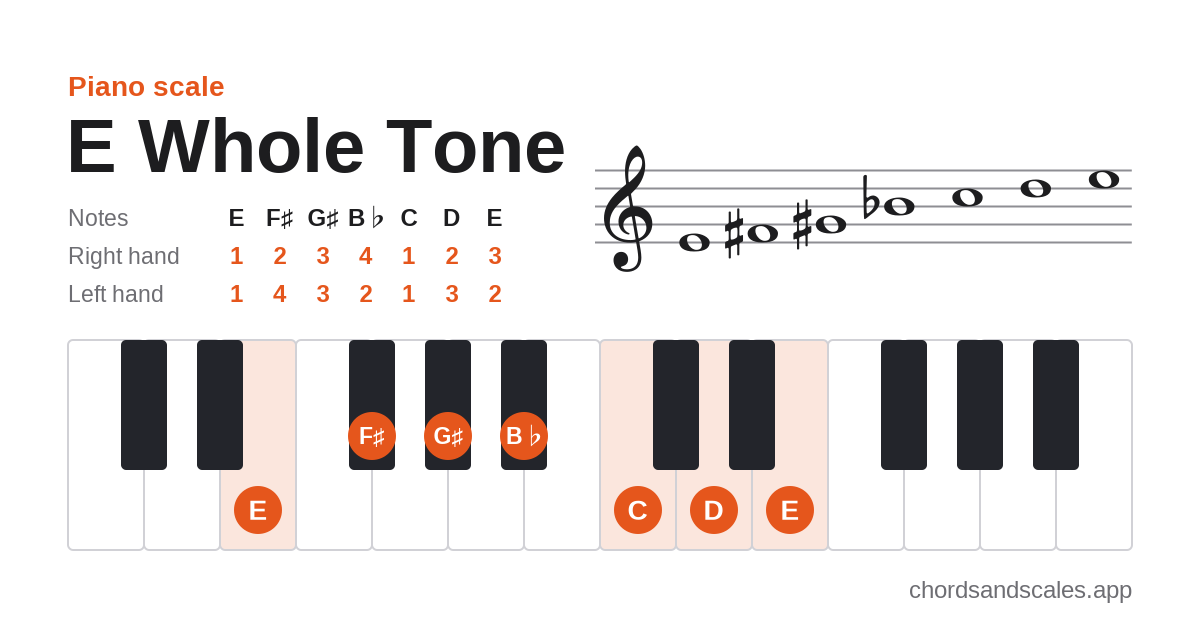
E Whole Tone scale fingering
Fingers are numbered the same way in both hands: 1 is the thumb, 2 the index finger, 3 the middle finger, 4 the ring finger and 5 the little finger. The fingering covers one octave, from E to E. Going down, both hands use the same fingers in the reverse order.
Right hand
1 2 3 4 1 2 3
Start on E with finger 1. The thumb passes under to C.
Left hand
1 4 3 2 1 3 2
Start on E with finger 1. Finger 4 crosses over the thumb to F♯ and finger 3 to D.
| Note | E | F♯ | G♯ | B♭ | C | D | E |
|---|---|---|---|---|---|---|---|
| Right hand | 1 | 2 | 3 | 4 | 1 | 2 | 3 |
| Left hand | 1 | 4 | 3 | 2 | 1 | 3 | 2 |
Notes of the E Whole Tone scale
The table gives every note with its degree, its place in the major scale on E, and its distance from E. Three of the notes, E, G♯, and C, are the E augmented chord, the chord the scale is most at home over.
| Degree | Note | From E |
|---|---|---|
| 1 | E | root |
| 2 | F♯ | major second |
| 3 | G♯ | major third |
| ♭5 | B♭ | diminished fifth |
| ♭6 | C | minor sixth |
| ♭7 | D | minor seventh |
Related scales and chords
Hear every scale, see the fingering of both hands note by note, and practice it with the metronome in the full app: 43 scales in every key.