E♭ Whole Tone Scale
- Notes
- E♭ F G A B D♭
- Also called
- E♭ whole-tone, E♭ hexatonic whole tone
- Steps
- W W W W W W
- Degrees
- 1 2 3 ♯4 ♯5 ♭7
- Key signature
- none, sharps and flats are written as accidentals
- Typed
- Eb whole tone (b for ♭)
The E♭ Whole Tone scale has six notes: E♭, F, G, A, B, and D♭, then E♭ again an octave higher. Every note is a whole step from the next, so the scale has no half step, no perfect fifth and no note that sounds like home. Only two whole tone scales exist: the scales on F, G, A, B, and D♭ have the same notes as this one, and the other six share the second set. Every note of it carries an augmented chord.
In the step pattern W is a whole step (two keys further on the piano, black keys counted) and H a half step (the very next key). The degrees compare each note with the major scale on E♭: ♯4 is its fourth note raised a half step.
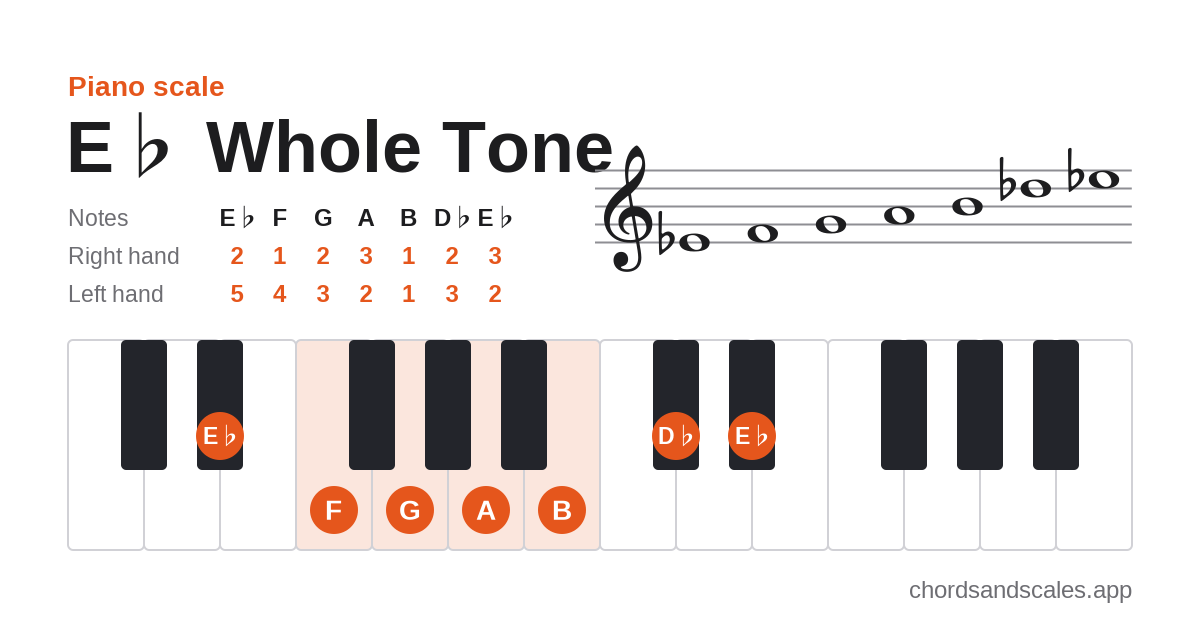
E♭ Whole Tone scale fingering
Fingers are numbered the same way in both hands: 1 is the thumb, 2 the index finger, 3 the middle finger, 4 the ring finger and 5 the little finger. The fingering covers one octave, from E♭ to E♭. Going down, both hands use the same fingers in the reverse order.
Right hand
2 1 2 3 1 2 3
Start on E♭ with finger 2. The thumb passes under to F and to B.
Left hand
5 4 3 2 1 3 2
Start on E♭ with finger 5. Finger 3 crosses over the thumb to D♭.
| Note | E♭ | F | G | A | B | D♭ | E♭ |
|---|---|---|---|---|---|---|---|
| Right hand | 2 | 1 | 2 | 3 | 1 | 2 | 3 |
| Left hand | 5 | 4 | 3 | 2 | 1 | 3 | 2 |
Notes of the E♭ Whole Tone scale
The table gives every note with its degree, its place in the major scale on E♭, and its distance from E♭. Three of the notes, E♭, G, and B, are the E♭ augmented chord, the chord the scale is most at home over.
| Degree | Note | From E♭ |
|---|---|---|
| 1 | E♭ | root |
| 2 | F | major second |
| 3 | G | major third |
| ♯4 | A | augmented fourth |
| ♯5 | B | augmented fifth |
| ♭7 | D♭ | minor seventh |
Related scales and chords
Hear every scale, see the fingering of both hands note by note, and practice it with the metronome in the full app: 43 scales in every key.